It is currently a draft format, and corrections, remarks, format, as fixing my bad English is under way.
The goal of this paper is to present the first elements toward a Psycho-Sociocultural Explanation for the famous airship wave of 1896-97; in other words, an explanation without resorting to mysterious or Fortean entities, and in accordance with the economy of hypotheses principle (Occam's Razor).
*
**
***

Artist's drawing and illustration of a newspaper article about a mysterious airship allegedly seen by a large number of witnesses, The Chicago Times-Herald, 12 april 1897.
Note: the bibliography is available at the end of this document when it concerns paper sources. When the source or help is on-line available, we use footnotes.
Introduction and Problematic
The first and probably more famous of the so-called Airships waves is the great one of 1896/18971. The problematic is that it exists, only or mainly in newspapers, a very important number of testimonies of sightings of such aircrafts, but, however until a scientific evidence of the contrary, such realizations manufactured by Mankind having flown in time and locations of these events are unknown by the aeronautic history.
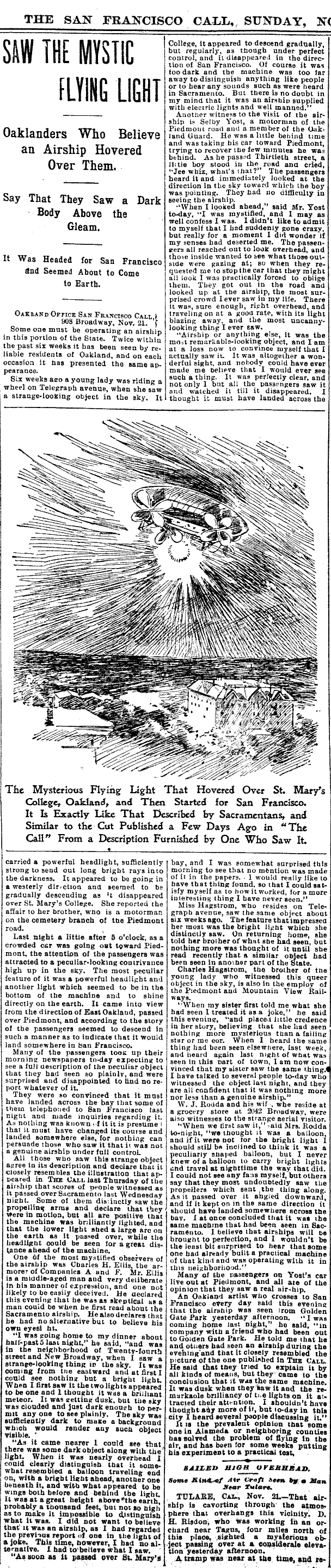
In other words, there are no historic or scientific evidences of the realization(s) and flight(s) of 1896/97 such designs explaining what was observed. The historiographical material for the investigator is then contemporary gazettes and newspapers. Despite the fact we read here or there it have been airship's sightings previously this wave, the principle sighting and important press article considered is the one about 17 November 1896 around 6 to 7 pm. A strange light is alleged to have overflown above the city of Sacramento in California, and dozens of individuals seem to have observed it, alleging an airship design or egg-shaped/cigar-shaped one. The second principle sighting is the one occurring at Oakland/San Francisco (California again), the 20 November 1896. The narratives are pointing an airship too. Such news mediatized by newspapers, and there is in around twenty States that will be airship's sightings in this end of November 1896 to 1897.
The first historical steerable airship was probably the one constructed by French inventor Henri Giffard (1852). On 24 September 1852, he realized the first powered and controlled flight (27 km) from Paris to Trappes, but the wind was too strong and he was unable to return to the starting point. However, he was able to make maneuvers, demonstrating a powered airship could be steered and controlled.
1 http://en.wikipedia.org/wiki/Mystery_airship

Model of Henri Giffard airship.
In 1884, a French airship taken again to the skies and it is generally presented as the first historical truly controlled dirigible. Called La France, it was designed by two French Army Captains, Charles Renaud and Arthur Krebs (165 feet long, 2 tons, 12 miles per hour). At least, seven flights were done and by five times, the dirigible was able to go back to its starting point. It was able to flight a distance of 8 kilometers in 23 minutes.

The “La France”.
In 1897 and in Europe, another real airship have attempted or have a fight success in the aeronautic history: The Austrian David Schwartz1 have been able to fly an airship the 3 November 1897 (crashed). His airship was ready September 18962, and a test scheduled for the 27 September, but the test was canceled. Another attempt was done on 8 October 1896, and the airship "dressed" in exterior, taking to "ground" by wires, but the quality of hydrogen was not reliable. We can read it have been able to move the design and to activate its machinery. In a Newspaper of Ozor, we read:
Yesterday, on Thursday, October 8th 1896, Schwarz's airship managed to lift only a few meters above the ground, while the soldiers were holding it with ropes. It is said that the gas used in the airship was bad, and thus the airship could not perform as expected. It was decided that the airship would be filled once again with good gas and tested.
http://en.wikipedia.org/wiki/David_Schwarz_%28aviation_inventor%29
http://croatian-treasure.com/schwarz.html

Test flight of Schwartz's airship, 3 November 1897, Tempelhof (Germany).
Next , we reproduce an non-exhaustive collection of dirigibles prototypes pictures collected by Dominique Caudron.

Collection of several airships prototypes by Dominique Caudron.
Of course, the real “golden age” of airships occurred in 1900, when Count Ferdinand von Zeppelin launched his Luftschiff Zeppelin 1 from a floating hangar on Lake Constance in the south of Bavaria.
If we are able to launch a promising piste in order to conventionally explain these two principles sightings of Sacramento and Oakland, it would be highly probable that the following sightings and testimonies would result from similar stimuli in nature, or would be the product of a mass or social contamination involving different other conventional variables. English speakers sociologists prefer the term mass delusion than social contamination, and noticeably by the works of Australian sociologist Robert E. Bartholomew1 or (Emeritus) American Professor Erich Goode2. Several cases where mass delusion would be involved are presented in an article of the Skeptical Enquirer (2000) online in the site of the Committee for Skeptical Inquiry, with an non-exhaustive bibliography. Bartholomew have been interviewed concerning Mass Delusion too3. The sociologist wrote different books like: Panic Attacks, the History of Mass Delusion; Outbreak!: The Encyclopedia of Extraordinary Social Behavior, Little Green Men, Meoving Nuns and Head-hunting; Panics: a Study of Mass Psychogenic Illness and Social Delusion. We will be back soon to Bartholomew in the following lines and mainly concerning his 1998 book, UFO& Alien Contact: Two Centuries of Mystery.
1 http://independent.academia.edu/RobertBartholomew
2 http://www.stonybrook.edu/commcms/sociology/people/faculty/goode.html
3 http://www.sciencemediacentre.co.nz/2010/08/17/robert-bartholomew-on-mass-delusions/

The Thesis of Ufologists and other Fortean Phenomenons Proponents
Taking into account the anachronistic variable of the crafts alleged, the sightings of this wave have been naturally a material or taken as an evidence for the ones of the investigators defending extraordinary hypothesis, like the visitation of extraterrestrial crafts, multidimensional visitors, time-travelers, or as the product of a sentient intelligence being or of an external and manipulator agent. First, we must notice that the Extraterrestrial Hypothesis (ETH) have been evoked in very few contemporary newspapers, but it was already proposed. Gregory L. Reece (2007, p.10-11) quotes the Stockton Evening Mail, 19 November edition (a California newspaper) using Daniel Cohen (1981) and Wallace O. Chariton's (1991). It is reported that Colonel H. G. Shaw have seen a craft in the ground, with three occupants who tried him to follow them, but they failed because they were not strong enough. The craft takes off after the occupants joined it. Shaw was on the opinion that, for him, the beings came from Mars.
The same book reports a St. Louis Post-Dispatch release of the 10 April 1897 concerning another close encounter by W. H. Hopkins, but with Human occupants, a man and a very beautifull woman, nude together. The witness is said to have attempted communication with gestures and signs, and one the occupant pronounced a vocalize which sounded as Mars word. Other examples are existing in different newspapers and gazettes.
Extraordinary thesis concerning the 1896/97 are not lacking in ufology, as Jean Sider's one in France1 and in particular in his French on-line article L'airship de 18972. More complex extraordinary hypothesis have been formulated here or there, for example by Swiss ufologist Fabrice Bonvin3. More complex because this kind of hypothesis are calling ufological coined terms like "mimic" or "elusivity". Such terms or concept are close the ones proposed by Jacques Vallée4 or John Keel5: It is defended that the origine of such wave or other so-called anomalistic phenomenons are imputable to an omniscient intelligence having a manipulator or insidious behavior.
The main arguments proposed to exclude any conventional possibilities by the proponents of such thesis and for the 1896/97 airships wave are for example the argument of a telecommunication network too low at this period and a too low literacy rate of the American population... Then, it would exclude all explanations in terms of mass contagion where newspapers and other networks were playing a very strong role:
Insufficient penetration of the communication network and the low literacy rate in 1897 exclude a shared spread of conscious representation of the phantom airship in a predominantly rural population.
1 http://fr.wikipedia.org/wiki/Jean_Sider
2 http://www.paranormal-info.com/L-airship-de-1897.html
3 http://feanor-journal.blogspot.fr/2009/08/maintenant-un-article-assez-pertinent.html
4 http://en.wikipedia.org/wiki/Jacques_Vall%C3%A9e
5 http://fr.wikipedia.org/wiki/John_Keel
We dont recognize this argument as solid, nor historically valid, but a fallacious one. As Dominique Caudron stated, first, what ever is a publication, the ones who have a reading knowledge may read for the ones who have not. Second, even if 10% of a population have reading knowledge, there are in fact only tens testimonies at a time, or less, and the ones knowing the rumor of Airships can repeat and vehiculate it orally and then become protagonists and actors of this contagion. Concerning a telecommunication network too low, we are at the edge of the Telegraph and Rails for 50 years. Phone is invented from around twenty years and more or less well implemented, mainly in California. For example, if we focuse on the principle sighting of Oackland, the San Francisco Call of 22 November 1896 (p.13) – the article is reproduced after for his main parts – and we read that some witnesses... have phoned to the Journal!
The main problem concerning the thesis invoking extraordinary entities or concepts is that they don't lend to the (scientific) verification.
Human Inter-Individual Variability in Perception, Memorization and Restoration of an Event or Stimulus
For three decades now, it have been presented by UFO-skeptics (mainly French speakers) what we call cognitive transposition mechanisms or processings (projective elaborations and transformations: conventional stimuli are "saucerized" by some subjects. As French Ufologist Michel Monnerie stated few decades ago1:
1 Quoted in http://archive.is/4QKwO
Ufologists, arbitrarily call the minor misinterpretations ‘false UFOs’ and the major ones ‘true UFOs’, and do not realize that there is a perfect continuity between the two series, and that the difference between them is of degree not of nature.
To illustrate this hypothesis that IFO (Identified Flying Objects), False UFO (pre-UFO but become IFO after investigation) and True UFO (Cases of Flying Objects not yet identified) may be in fact in continuity, and only conventional stimuli not identified, so a difference of degrees between them, but not of nature, we made the following figure:

In order readers better understand what we mean, we will take one example. We state that when individuals are assisting, memorizing and restoring a very same stimulus, the estimated parameters (like the size, distance, duration, colors, speed, angular size, etc.) will vary from one individual to another – inter-individual variability – It is what we have represented by this Bell Curve (by commodity). Then, the UFO corpus should be in fact largely constituted by these extremes.
What we call here extremes? French investigator Robert Alessandri have studied a case where 32 future French Gendarmes in formation have assisted to a very same stimulus the 5 November 1990 in France (the space reentry of Gorizont/Proton rocket body), and the day after, their instructor asked them to report this sighting and questioned them regarding several parameters1. Among them, there is the direction of the object (a space reentry then).
Alessandri obtained from this parameter reported in the narratives the following figure:
1 http://perso.numericable.fr/~wolf424/univers.ovni/

We have more or less a Bell Curve for this estimation of the cap/direction. The point is that, even if these 32 subjects have assisted together to the very same event, some individuals are giving directions totaly opposed to the others. Why? Because it exists an inter-individual variability when individuals perceive, memorize and restore an event or stimulus. Imagine now that the two narrations of the two witnesses giving SSE and NW as directions are taken by ufologists in some way (because these persons contacted a group of ufologists or ufologists reading their reports, etc.), and if, after an investigation we propose they have assisted to the space reentry (ENE was the real cap/direction of Gorizont/Proton rocket body space reentry), ufologists will constate that their estimations are around 90° of the proposed candidate. How future Gendarmes should have done such an error? It sounds without sens, and we will have two UFO solid testimonies, only because ufologists have not taken in the equation the inter-individual variability parameter when people have faced a same (and conventional) stimulus and are asking to provide a description containing parameters (or asked to give them). In reality, such two solid tales are here only the products of this variability. The (or a very large part) of the UFO reports, as the UFO phenomenon itself should be then and a epiphenomenon – a secondary phenomenon linked to another one (extremes in Human variability facing conventional stimuli in reality individuals didn't recognize for what they were and extremes in Human variability when estimating parameters as they are in reality – and an illusory phenomenon consisting to believe, to take and to think that the narratives and their contents would be another thing than the product of inter-individual variability. Variability, which made that a stimulus in reality conventional or mundane, because it is new for the observer, or seen under particular conditions, or not, and described after, will result to some extremes, to some over or under-estimations, and sometimes to a "saucerization", by many individuals. Rossoni, Maillot & Déguillaume (2007) already proposed:
It generally appears that if a majority of the reports are enough conform to the reality for anyone familiar with the phenomenon in question to be able to identify it with certainty for what it is, a strong minority mooves away significantly (by one or more erroneous details) and some transform to such an extent that the real stimulus is almost unrecognizable.
The ufologists in favor of exotic hypothesis behind the UFO would be then devoted in totality or in a very large part to this intrinsic product and result of this inter-individual variability concerning perceptions, memorizations and descriptions. And ufologists themselves projecting their own expectations, and we have here a retro-action loop, a circularity.
The reasons to drive some individuals to not identify a conventional stimulus in reality are numerous. They could be imputable to the observation conditions, because the stimulus is perceived in dark time, or other particular ones (fog, mist, atmospheric refraction, etc.), or because the stimulus is seen fleetingly, or under a non-prototypical angle of vision, or undergone particular artificial or natural light exposure (and so on).
To support these "projective" cognitive mechanisms (and among many other existing sources), it is possible to evoke the drawings of the October 1963 space-reentry or sociologist and geographer Edgar Wunder's experimental protocol1. Such terms as "projective" cognitive mechanisms came or have been coined by the SocioPsychological Hypothesis of the UFO Phenomenon (SPH) proposed by several French speaking UFO-Skeptics2.
The SPH stipulates in particular that when some individuals are facing stimuli they don’t recognize, subjects’ brains are making projective transformations and elaborations of the stimuli. If medias, like the ones of 1896/1897 selected only such extremes, because some journalistic reasons and motivations for sensationalism, we may have in reality a sort of biased sample of individuals, and a table of the wave and sightings with an internal homogeneity in disguise.
The individuals are thus using their own mental representations of the UFO phenomenon (or airship) or using what is vehiculated by a prevailing or surrounding culture, which changes among the time, therefore explaining "the plasticity of the UFO-phenomenon" (Kotmeyer 1993, 1996, 1998, 2001; Binder, 1967).
1 http://ufo-scepticisme.forumactif.com/t3937-les-dessins-de-temoins-d-une-rentree-atmospherique-un-nouveau-coup-porte-a-l-het-vehiculaire#69695
2 French:
http://scepticismescientifique.blogspot.fr/2009/08/lhypothese-sociopsychologique-ce-quelle.html by my Belgium friend Jacques Scornaux.
http://www.zetetique.fr/divers/OvniDuCnes_annexe.pdf by our french UFO-skeptic forum members David Rossoni, Éric Maillot & Éric Déguillaume.
http://www.unice.fr/zetetique/articles/theorie_reduct_ovni.html by Claude Maugé.
English (old articles) :
The Rising and the Limits of a Doubt by Jacques Scornaux.
http://archive.is/4QKwOQuestioning the ‘Real’ Phenomenon by Claude Mauge.
http://magonia.haaan.com/2010/questioning-the-real-phenomenon-claude-mauge/
Particularly, it is interesting to take into account the drawings of space reentries1 to show these projective mechanisms are factual and empirically demonstrated. For example, here are some drawings made by some witnesses who have in reality assisted to different space-reentries:
1 In particulary pp 16/18/21 this pdf. James Oberg shared http://www.jamesoberg.com/10-30- 1963_kiev.pdf

"Sue" and "Sarah" drawings reconstituting an UFO around Haystack Mountain, but the second stage of Cosmos 2315 space-reentry in reality.

A drawing made by a Russian witness despite the fact that what he perceived was Kosmos-20 booster space reentry.

If you are curious about how space-reentries produce UFO reports, Tim Printy wrote an article in his site, The Rockets Red Glares: How Satellite reentry's and meteors produce UFO Reports1.
1 http://home.comcast.net/~tprinty/UFO/rocket.htm
German Sociologist Edgar Wunder has done an interesting experiment too: he proposed, using a screen, land pictures where a little stimulus without real signification is placed in the sky and asked, after the presentation of the slides, his subjects to draw what they saw. Again, many drawings show that subjects have "saucerized" the stimulus, adding structure(s), windows, propulsion, motors, etc.2 Such dataes sounds very interesting for cognitive psychology and a means to help understand the UFO phenomenon better. In other words, SPH is laboratory testable.
2The links are the following (jump to part 2, around 3'20'' and part 3 of course).
Galileo Mystery - Ufos
http://www.myvideo.de/watch/4119891/Galileo_Mystery_Ufos_Teil_1
http://www.myvideo.de/watch/4119917/Galileo_Mystery_Ufos_Teil_2
http://www.myvideo.de/watch/4119949/Galileo_Mystery_Ufos_Teil_3

Example of Slides used in Edgar Wunder's experiment.

One drawing obtained by Edgar Wunder Experiment. The individual have “saucerized” the initial stimulus.
What may explain cognitively what is happening here?
Projective Transformation: Witness is seeing elements in line with his own "expectations" and is altering the characteristics of the stimulus during the perception. (Such processings are called in cognitive psychology, top-down processings versus bottom-up ones) or "driven by the concepts processings" (versus “driven by dataes processings”). It is well known that our knowledge and our culture influence what we perceive in the environment, and influence the retrieval and the return of the event (by memory processes). Stored information from different sources can therefore complement, anticipate or replace what we see, mainly when the stimulus is not recognized as a "world element" because it’s too ambiguous, too fast, unknown, etc.
Some witnesses then "saucerize" the stimulus and ufologists jump on these tales.
During an UFO wave, for example, a witness is encouraged to see the sky, and will add a detail or details that create the structure of the observed but not identified stimuli (prosaic/conventional stimuli in reality) as the likeness of a UFO broadcast by the media (see after).
Projective Elaboration: The witness gradually develops a "cultural roman" during perception, adorned with many subjective and false memories (see after). A witness will evoke illusory physical interference of the UFO with the environment, providing psychological and/or physiological effects, an amalgamation, of disparate elements close in time and space of the sighting, but having no relation between them in reality.
In other words and concerning the 1896/97 airships wave, did the witnesses project their conscious or unconscious prevailling or surrounding knowledge of airships on another observed object, transforming it into something that looks less and less to the actual stimulus, and much more in line with expectations of aiships?
Memory Malleability, Biases and False Memory
The memory illusions are usually the result of errors in the reconstruction of the past experience, but "bugs" may occur following the encoding phase during the passage of the sensory information from the working memory or short memory to the long term memory. Facing to the same event, an individual is encoding different items depending on his physiological or emotional state too. Thereafter, parasitic information may confuse memory, easily slipping into the remembered episode.
The witness then comes to the intuitive certainty of having seen, heard or done something when he only has "imagined" or more exactly inferred it. These errors may have an endogenous cultural/mental representations (see after) but also be induced by a third party, by mere suggestion; i.e., when interacting with investigators/ufologists/journalists who suggest intentionally, inadvertently or not, what they expect. Yes, the way a question is asked, for example, is likely to blur the memory of the one who responds. That's why ufologists should use standardized interview procedures as those in criminology or psychology which minimize such well-known biases (cognitive interview procedure, see after).
A false memory, created from scratch, results generally in a source of confusion: the subject correctly remembers the information, but no longer knows where it comes from. Some false memories and dreams are then remembered as real events. The literature concerning false memory in cognitive psychology is really abundant and a very fecund field of scientific studies, but Elizabeth Loftus1 is probably the most famous researcher focused on this thematic. These field of researches concerning Human Memory have experimentally demonstrated how our memory is malleable and plastic. In Appendix A, I shortly present some of the memory effects discovered and studied in cognitive psychology as I did in my book (Fernandez, 2010).
The practice of regressive hypnosis used by some ufologists to bring to the surface so-called repressed memories has also created amazing confabulations (for example, Arndt & Greenberg, 1996; Banaji & Kihlstrom, 1996; Clancy & Pitman, 2002; Clark & Loftus, 1996; Lynn & Irving, 1996; McNally & Clancy, 2005; Orne & Al., 1996; Otgaar, Candel, Merckelbach & Wade, 2009; Ross & Newby (1996); Strube, 1996; Swami, Pietschnig, Stieger & Voracek, 2011). Hypnosis increases the illusion of remembering and actually makes the hypnotized person more vulnerable to memory distortions and inferences. Some people are described by psychologists as fantasy-prone personalities, convinced of having experienced events that have not actually occurred (Wilson & Barber, 1983; Lynn & Rhue, 1988; Merckelbach, H. et al., 2001). Such people are characterized by a singular disposition to fantasize and sometimes find it difficult to distinguish real events from the products of their imagination: dreams, scenes from movies/books they have seen or read or events they just heard or which were rumored by medias. Again, to "test" witnesses by psychometric or personality tests sound a precious tool for the investigator, as to evaluate their social and cultural environment, in order to solve these so-called mysteries from UFO, abductions to other paranormal thematics. The cultural environment provides subjects with images, mental representations that they model their interpretation of experiences with (see after).
A better understanding of mechanisms of treatment (perception and recognition), storage, organization (memory) and modification of sensory information here should help to refine and complete the SocioPsychological model of the UFO phenomenon. Again, what it is interesting here is that it is testable in laboratory by psychology experiments. It changes so-called ufology which is often made of non-testable assumptions, hypothesis, etc.
We could add for our following purpose simple perceptual misinterpretations, hoaxes and mystifications (rare), altered states of consciousness (due to fatigue, sleep paralysis, for example), psycho-pathological experiences (rare too), secret military experiments or objects as source of an UFO sighting (or deliberately provoked "mirage men" approach to hide secret devices), and even rare or poorly known geophysical phenomena (sprites, elves, etc.).
Psycholo-Sociocultural Hypothesis applied to the 1896/97 Airships Wave
We will now present evidences that before the airships wave started (November 1896) with the two principle sightings (Sacramento and San Francisco/Oakland), a cultural imagery of Airships was pre-existent at that time, but more so in California, where the wave started, and this pre-existent material appeared in the same media "recording" the wave: the area newspapers. Local California people may have been already "prepared" culturally to see airships which made it possible for them to see what they wanted to see or were expecting to see.
We then suggest that the two principle sightings (San Francisco/Oakland 20 November 1896 & Sacramento 17 November 1896), as other “famous ones, highly met potentially matching and explainable conventional stimulus. With these evidences, we propose that local people saw what they expected to see and that the two principle sightings had a potential conventional candidate (conventional stimulus they have transposed, elaborated and transformed due to the favorable surrounding and prevailling cultural ambiance and expectations in time and place of such sightings). We suggest that these two sightings, described by newspapers among California and other States launched a mass delusion (psychosocial contagion, see later) which resulted in the 1896/97 Airship wave.
Social psychology have in several studies demonstrated the tendency to individuals to conform (Asch,1956; Krech, Crutchfield, & Ballschey, 1962) and it is probably particularly here the case. Social psychology have shown how it is common that individuals, even though they were not told to agree specifically between them or even though cautioned about influence, they change or shift their judgment to the common and normed one (Sherif & Harvey, 1952). Social influences appears when emotions, opinions, or behaviors are affected by others. Conformity is the behavior of matching attitudes, beliefs, and acts to group norms. Human Sciences like social and cognitive psychology studied what they call the “normative social influence”, the conformity to the influence of a majority due to informational social influence. This means that individuals tend to adopt the behaviors of the majority of a group (to not be left out, for example). The individuals “really” do not believe the majority, they simply comply in order to be accepted. Several studies pointed the informational social influence: when a situation is ambiguous, individuals have a tendency to conform to the majority because it is a source of information. In other words, if an individual is unsure as to the correct answer or behavior, then they tend to believe the majority opinion (or behave accordingly). The majority opinion is internalized by individuals in order to be “right”.
Another important point regarding cognitive psychology is that the studies indicates that during ambiguous situations or stimuli (like to scan the sky in evening or dark times, with the expectation to see airships as it is articulated by medias or by a particular surrounding or prevailing culture):
inference can perform the work of perception by filling in missing information in instances where perception is either inefficient or inadequate" (Massad, Hubbard & Newston, D., 1979 quoted by Bartholomew and Howard, 1998).
Or as Rossoni, Maillot & Déguillaume (2007) wrote:
When you do not know what you see, or if you already believe to know what you will see, our perception can therefore be easily distorted.” [...] “In general, the prevailing culture does not drive people to see things they do not know how to interpret, but provides them the contrary: an interpretation grid for the things they do not recognize.
Massad, Hubbard & Newston (1979) concluded that individuals may differ in their initial perception of an event as the result of differences in prior expectations, and that the resulting biased sample of information they acquire may limit their retrospective reinterpretation of the event. Selective perception in cognitive psychology is the personal filtering (and then selective) of what we see and hear so as to suit our own needs and expectations. Much of this process is psychological and often unconscious. Fernandez (2010) mentioned the Halo effect which is similar: The halo effect has to do with judging or evaluating a person, place, event or even a mark or event by a single trait or experience. This overall impression can be good or bad but will prejudice our further involvement with the stimulus. The Halo effect have been studied for long time in cognitive and social psychology (Back, Wiley & Sons, 1977; Bourdieu, 1979; Maisonneuve, 1966; Moscovici, 1979; Rosenthal & Jacobson, 1971). They are many cognitive biases probably in play to generate such a mass delusion, like attentional bias, which is the common tendency to focuse attention to emotionally dominant stimuli in one environment and to neglect relevant data when making judgments of a correlation or association (Sass & al., 2010) or well studied availability heuristic which is the tendency to overestimate the likelihood of events with greater availability in memory, which can be influenced by how recent the memories are or how unusual or emotionally charged they may be (Bless, 1991). Discussions, newspapers readings drive individual to availability cascade, which is the self-reinforcing process studied in psychology in which a collective belief gains more and more plausibility through repetitions in public (or medias) are occurring and increasing (Timur & Sunstein, 1998). The tendency or effect to do and believe things because many other people do or believe the same thing too have been studied by psychology in the main fields of researches called group-think (ie: Tsoukalas, 2007) and herd behavior (ie: Raafat, Chater & Frith, 2009).
If people have an high believability of a conclusion, they are biased for the thing or stimulus they are evaluating (Klauer, Musch, & Naumer, 2000).
Probably the main bias we can evoke here is the confirmation bias, generally summarized as the tendency of individuals to favor information that confirms their own beliefs or hypotheses. People display this bias when they gather or remember information selectively, and they tend to interpret ambiguous evidence as supporting their existing position and are making illusory correlation1.
1 http://en.wikipedia.org/wiki/Illusory_correlation
A Pre-Existent Cultural Imagery
Of course, Jules Verne's novel Robur the Conqueror is considered as one the most famous pre-existent cultural imagery. It is easy to find it and it has already been presented. But we will present another ones (among others). French investigator Dominique Caudron made a research about the occurrences of the term "Airship" and how many times it appears in newspapers found in the Library of Congress until only: He found up to 1841, 49 826 results.
In 1893, 3 years before the wave, there was this illustration by Frank Reade, Jr.:

More interesting for our concern, there is this picture, appearing very short before the wave and in California exactly where the wave started, in The San Francisco Call, 1 September 1896, we reproduce the next page. Did it help generate the wave?

Our research indicates that C.A. Smith deposed a patent April 1896, patented August 18961 (but we don’t endorse or think that such machines ever flew for several reasons: the development of various prototypes by inventors was not advanced enough to explain the wave, see after). Curiously for our concern, Charles Abbott Smith was a resident of San Francisco and then California, we read:
1 http://www.google.com/patents?id=I6hmAAAAEBAJ&printsec=abstract&zoom=4&hl=fr#v=onepage&q&f=false
Be it known that I, CHARLES ABBOTT SMITH, a citizen of the United States, residing at San Francisco, in the county of San Francisco and State of California, have invented, certain new and useful Improvements in Aeronautics; and I do declare the following to be a full, clear, and exact description of the invention, such as will enable others skilled in the art to which it appertains to make and use the same, reference being had to the accompanying drawings, and to the figures of reference marked thereon, which form a part of this specification.
We reproduce a picture of his Airship coming from his patent:
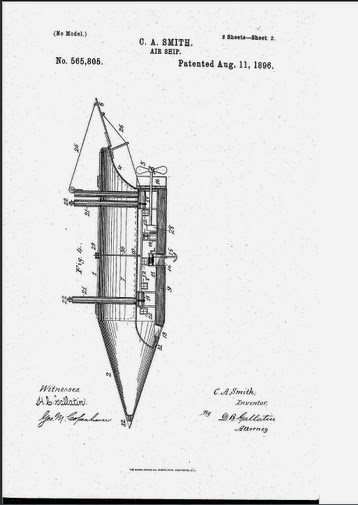
It is evidences supported that a surrounding and prevailling cultural imagery of Airships pre-existed the wave in time (just before the wave itself) and in the very same place (California) where the wave started and in the very newspapers which fostered the propagation of the wave. You will find others sources supporting this cultural imagery in the next pages.
A Potential and Conventional Candidate for the Two Principle Sightings (Sacramento and San Francisco/Oakland)?
The following capture represent San Francisco/Oakland's sighting in the very same newspaper as that of the previous C.A Smith picture, and the text published on 22 November 1896, p. 13. Notice the object disappeared S.W.:

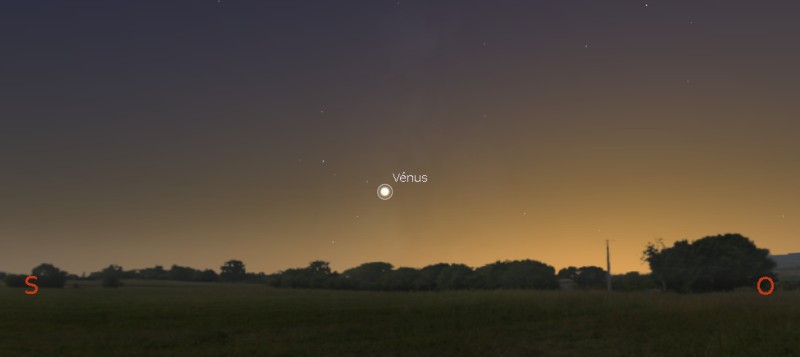
We realized a Sky reconstruction with Stellarium software for this 20 November 1896, 17H30 Pacific Time (i.e., the Charles Ellis sighting).

Venus, the “Queen of UFO” (see future reference), is there, moving more and more to the horizon, finishing Her course. Notice that the testimonies never mention Venus, or take Her as a landmark...
What about the famous Sacramento sighting of 17 November 1896 and what are stating the witnesses in the newspapers? We find the following quotes1, The ship "moved slowly away in a southwesterly direction …"; "Toward the southwest …"; "Moving in a southwesterly direction …"; "Its southwesterly course …".
Again Venus appears as a highly potential and conventional candidate for the sighting.
In conclusion at this stage, a pre-existent cultural imagery and prevailing/surrounding culture regarding the airships were taking place just before the wave and in the very same place, California, and with the complicity of Californian newspapers where the two principle sightings took place and where future sightings will be recorded and vehiculated. For the two, Venus appears as a good stimulus or candidate for the actual stimulus that caused some people to have projected what they wanted to see – Airships. "A la Kenneth Arnold" for the UFO 1947, these two principle sightings were largely made tangible as airborne vehicles by newspapers.
All was in place to generate a mass delusion like an UFO Wave, excepted individuals saw airships and not “flying saucers” (there was not flying saucers prevailing cultural imagery at this period, of course). Pro-eminent UFO-skeptic Philipp Klass (1986, p.103-104) defined UFO wave as it follows (we can replace UFO by airships):
1 http://cdnc.ucr.edu/cdnc/cgi-bin/cdnc?a=d&d=SFC18961119&e=-------en--20--1--txt-IN- San+Francisco+Chronicle----#
Once news media coverage leads the public to believe that UFOs may be in the vicinity, there are numerous natural and man-made objects which, especially when seen at night, can take on unusual characteristics in the minds of hopeful viewers. Their UFO reports in turn add to the mass excitement which encourages still more observers to watch for UFOs. This situation feeds upon itself until such time as the news media lose interest in the subject, and then the "flap" quickly runs out of steam.
Or Tim Printy to state1
1 http://home.comcast.net/~tprinty/UFO/Klass.htm
People are just not knowledgeable about the night sky to determine what they are looking at is not a UFO. There are satellites, bright planets, highflying aircraft, bright meteors, and other phenomena that the casual observer just does not understand. Once it is planted in their minds that strange objects in the sky are probably UFOs, then it does not take much for individuals to link the event with the newspaper stories.
Mass or Collective Delusion
In Chapter 10 of the book Ufos & Alien Contact: Two Centuries of Mystery, Bartholomew and Howard (1998) defined the concept Mass Delusion in sociology or psychology uses. They wrote:
The word “delusion” is used by psychiatrists to describe a persistent pathological belief associated with serious mental disturbance, usually psychosis. Sociologists and social psychologists use the term “collective delusion” or “mass delusion” in a different sense, to describe the spontaneous, temporary spread of false beliefs within a given population. Excluded from this definition are mistaken beliefs that occur in an organized or ritualistic manner. This term is also a common source of confusion since it is often used as a catch-all category to describe a variety of different behaviors under one convenient heading.There are several types of mass delusions, four of which have some association with UFOs: immediate community threats, community flight panics, wish-fulfillment, and small-group scares. Mass delusions differ from prominent religious myths and popular folk beliefs in that the former occur in an unorganized, spontaneous fashion, although they may become institutionalized. Examples of such institutionalization include forming organizations intended to confirm the existence of alien visitors.History is replete with examples of group delusion, many of which may seem humorous to those outside the historical or cultural setting. For instance, in 1806 near Leeds, England, people became terror-stricken, believing that the end of the world was imminent after a hen began laying eggs with the inscription “Christ Is Coming.” Masses of people thronged to glimpse the miraculous bird until it was discovered that the eggs had been inscribed with a corrosive ink and forced back into its body. This is one of many examples from Charles Mackay’s 1852 classic, Memoirs of Extraordinary Popular Delusions and the Madness of Crowds. Unfortunately, the outcomes of group delusions are often more sinister: Nazism, mass suicide, moral witch-hunts, hunts for real witches, Communist infiltration scares, the Crusades, and unfounded fears about the casual transmission of AIDS, to name but a few.While some historical episodes of collective delusions are legendary, modern occurrences are remarkably similar. The four types of delusion mentioned above all involve a rapid spread of false-but plausible-exaggerated beliefs that gain credibility within a particular social and cultural context. They can be positive and take the form of wish- fulfillment, but are more often negative and spread by fear. Rumors are an essential ingredient common to each category of delusion. As people attempt to confirm or dismiss the accuracy of these unsubstantiated stories, everyday objects, events, and circumstances that would ordinarily receive scant attention become the subject of extraordinary scrutiny. Ambiguous happenings are soon redefined according to the new definition, resulting in a self-fulfilling prophecy. Many factors contribute to the spread of delusional episodes: the mass media, low education levels, the fallibility of human perception, cultural superstitions and stereotypes, group conformity, and reinforcing actions by authority figures, such as politicians, or institutions of social control, such as police or the military.
Neuroscientist Steven Novella on-line article UFOs: The Psychocultural Hypothesis1, as an excellent article by David Clarke, The Airships Wave of 19092 defend such a SPC approach too. You will probably find a similar SPC approach in terms of Mass Delusion in Mass Delusions and Hysterias: Highlights from the Past Millennium3 by Robert E. Bartholomew and Erich Goode.
1 http://www.theness.com/index.php/ufos-the-psychocultural-hypothesis/
2 http://www.ufo.se/english/articles/wave.html
3 http://www.csicop.org/si/show/mass_delusions_and_hysterias_highlights_from_the_past_millennium/
Another excerpt of Bartholomew & Howard (1998), book full of
informations and defending a very similar approach, and presenting an
important amount of historical sources and academic and scientific
papers to support the thesis. For example, the two authors state:
Since an observer’s mental outlook at the time of the sighting is of key importance, the context of the episode is very significant. The 1896–97 airship sightings occurred amid widespread rumors that a flying machine was on the verge of being perfected. Many Americans believed that such a dramatic achievement was at hand, and their emotions were stoked by speculative and often fabricated newspaper stories. As people began searching the skies f or confirmation of the airship-invention stories, they expected to see airships, and did see them. Whereas modern sightings consist almost exclusively of “flying saucers” from outer space, citizens in 1896–97 were predisposed by popular literature of the era to see airships. The overwhelming majority of reports occurred at night and described ambiguous lights viewed at a distance. It is not surprising that given these circumstances, residents interpreted information in ways that were consistent with their view of the world.
Studies on the fallible nature of human perception and the tendency for people in group settings to conform are especially applicable1. The human mind does not gather information like a videotape recorder. Humans interpret events as they perceive the world and often come to opposite interpretations of the same event witnessed under nearly identical circumstances, as anyone who has watched a hotly contested sporting event can attest. Perception is sometimes based more on inference than on reality, allowing for interpretations that often differ substantially from what actually exists. Research on autokinetic movement is applicable to such situations, as it concerns problem- solving dynamics2. The variance of interpretations from what actually exists is especially noticeable with the perception of ambiguous stimuli or conflicting patterns of information within a group setting, which will result in members developing an increased need to define the situation, depending less on their own judgment for reality validation and more on the judgment of others for reality testing.
When the stimulus situation lacks objective structure, the effect of the other’s judgement is . . . pronounced. . . . In one . . . study of social factors in perception utilizing the autokinetic phenomenon, an individual judged distances of apparent movement first alone and then with two or three other subjects. This unstructured situation arouses considerable uncertainty. Even though they were not told to agree and were cautioned against being influenced, the individuals in togetherness situations shifted their judgement toward a common standard or norm of judgement. . . The influence of various individuals differed, and the emerging common norm for judgement was in various instances above or below the average of individual judgements in the initial session alone3.Research on the “autokinetic effect” is of more specific interest as it has been shown that individual judgments tend to agree in a group setting while observing the common stimulus of a pinpoint of light within a dark environment. This effect is well known among social psychologists and was first demonstrated in 19364. Individuals in situations lacking stable perceptual anchors begin to feel a sense of uneasiness, then anxiety as they have a heightened need to visually define or make sense of the light. In group settings, individuals will attempt to reduce the anxieties created by an uncertain situation.A viewer in a completely dark room seeing one pinpoint of light experiences a visual stimulus without its normal attendant visual context. Up, down, back, forward, far and near, exist in relation to other stimuli and when this frame of reference is missing, the light is free to roam in one’s perceptual field. It is for this reason that considerable random motion will be experienced by anyone viewing the light5.
1 S. E. Asch, “Studies of Independence and Conformity: A Minority of One Against a Unanimous Majority,” Psychological Monographs, 70 (1956); D. Krech, R. S. Crutchfield, and E. L. Ballschey, Individual and Society (New York: McGraw-Hill, 1962).
2 R. Turner, and L. Killian, Collective Behavior (Englewood Cliffs, N.J.: Prentice-Hall, 1972), p. 35.
3 M. Sherif and O. J. Harvey, “A Study in Ego Functioning: Elimination of Stable Anchorages in Individual and Group Situations,” Sociometry 15 (1952): 272–305.
4 M. Sherif, The Psychology of Social Norms (New York: Harper and Row, 1936).
5 R. Beeson, “The Improbable Primate and the Modern Myth,” in G. Krantz and R. Sprague, eds., The Scientist Looks at the Sasquatch II. (Moscow, Idaho: University Press of Idaho, 1979), p. 180.
During highly ambiguous situations, such as people scanning the nighttime skies for an imaginary but plausible airship,
inference can perform the work of perception by filling in missing information in instances where perception is either inefficient or inadequate.”1
1
C. M. Massad, M. Hubbard, and D. Newston, “Selective Perception of
Events,” Journal of Experimental Social Psychology 15 (1979): 513–32.
From the same book, we can found this excerpt :
It was within this context that a telegram appeared in the Sacramento Evening Bee of Tuesday, November 17, 1896, in which a New York entrepreneur claimed that he would pilot his newly invented airship to California, which he vowed to reach within two days. That very evening the first recorded sightings of the cigar-shaped airship occurred as hundreds of Sacramento residents reported seeing it1
1 “Voices in the Sky . . . People Declare They Heard Them and Saw a Light,” Sacramento Evening Bee, November 18, 1896, p. 1.
This is again another element or fact supporting our main hypothesis that a pre-existent cultural imagery, from previous books, as pre-wave newspapers may have leaded people to see what they wanted and expected to see, Airships, where in reality it was other conventional stimuli. It appears, as already presented that Venus is a good candidate for such misinterpretation for the two principle sightings, celestial candidate which some people may have elaborated, transformed by the cognitive mechanisms we have mentioned.
Notice that we are not the firsts to think it, 1896/97 contemporary astronomers already done, read for example this on-line article by Tim Printy, Venus: The Queen of UFO1, where you will find some newspapers excerpts evoking celestial pistes, like the following one.
1 http://home.comcast.net/~tprinty/UFO/Venusufo.htm

Or Cambias, in his 1996 article, The Amazing Airship of 18961, where he already wrote:
1 http://www.balloonlife.com/publications/balloon_life/9607/airship.htm
The most likely culprit is the planet Venus. During the winter of 1896-97 it was visible in the evening sky, and was at its maximum brightness on March 23 - just at the height of the airship mania. Many of the airship reports were on cloudy or overcast nights. The bright disk of Venus shining through moving clouds might appear to be an airship in flight.
Sociologist Robert Bartholomew defends again a SPC approach in The Illinois UFO Mania of 1897,Why We Should be Leery of Modern-Day UFO Reports and wrote concerning the 1896/97 Airships wave the following sentences which is a good summarize of the approach and explanation we are defending too:
What is the most likely explanation for the sightings? In the heat of excitement, did witnesses suddenly lose rationality and take on a herd mentality? Were they purely imagining things? Very few witnesses are likely to have created their perceptions from pure imagination alone, but were likely misperceiving existing objects their environment such as stars and planets. I think we need to look no further than basic theories of social psychology. Human perception is highly unreliable, and influenced by a one's "mental set" at the time of an observation. Stars and planets often appear to move, change colors and flicker, and misidentifications of stars and planets are the most common explanation for contemporary UFO sightings. By examining the historical context of UFOs over the past two centuries, we are afforded a fascinating array of similarities including close encounter cases. The only significant difference between these two periods is the UFO form. During the 1897 wave in Illinois, people expected to see airships, while today they expect to see saucer-shaped UFOs. In each instance, residents saw, or thought they saw — exactly what they expected.
(To be continued).
Appendix A: Some Memory Effects.
We will list some key-words (non-exhaustive then) around the false memories syndrome and human memory in order readers realize that human memory is fallible and this have been scientifically demonstrated with fecund fields of research, mainly in cognitive psychology.
False Memory: Cognitive psychological term designing the creation of erroneous memories that the individual will however taking into account as real and this with a perfect good faith (Brédart, 2004; Loftus, 1979, 1980, 1993; Loftus & Hoffman,1989; Loftus & Ketcham, 1997; Loftus & Pickrell, 1995; Roediger,& McDermott,1995; Schacter, 2002, 2003).
Memory Conformity: Matching of the memories of one individual with the ones of another individual(s), in a discussion between them for example(Wright, Self, & Justice, 2000). This bias may happen to a testimony collect when the speech and discussion have been consciously or not oriented. Memory conformity is a particular case of the effect(s) of informations presented after an event on the memory of this event. The post-event informations are integrated by the individual to his memories despite they are in reality external. When evoking or restoring his memories, the invidual have the impression that these external informations are the reality of what he is evoking, despite these informations have been transmitted later the event he is restoring. Daniel Bernstein et al. have demonstrated such effect in the rememoration of old events (Bernstein, Whittlesea, & Loftus, 2002; Bernstein, Rudd, Erdfelder, Godfrey & Loftus, 2009).
Restrospection bias: Memory bias consisting to conform own memories to the judgments, behaviors, opinions, states and beliefs of the observers of your narration (as witness) or of people recording it. By conformism and suggestion/suggestibility, the initial memories is contaminated Conway & Ross, 1984).
Imagination Inflation: Effect demonstrating that if we demand to individuals to imagine hypothetical events, we increase the confidence level and veracity that such individuals will have later to judge such events have really happened to them, and are not hypothetical, but real (Garry, Manning, Loftus & Sherman, 1996).
Suggestibility: It is when an individual integrates in his memories erroneous elements coming from external sources vehiculated by the ambient culture or by other individuals in reality.
Revelation Effect: It is in a recognition test, the committed error consisting to judge old, items (like figures, objects, letters) which are degraded, distorted, disguised, or step by step revealed to the individual and which must been discovered, despite they are not older in reality (Watkins & Peynircioglu, 1990).
Impoverished Relational-Encoding: Hege & Dodson's validated hypothesis to explain how distinctive informations are reducing the false memories apparitions. Distinctive or different informations interfere with the relational or associative informations which are the ones and the main base to create or induce false memories. In other words, it must be presented distinctive and different informations in order the individual blocks his relational, emotional or associative ones, in order to become and to stay objective (Hege & Dodson, 2004).
False Recognition: Erroneous recognition in the sens we recognize elements, but they have been not memorized in reality (Norman & Schacter, 1997).
False Recall: idem, but this time, concerning the memory recall and not only recognition (Roediger & Robinson (1997).
Hotspot: This term designs the detailed memories of the more intense moment of the emotional distress concerning a traumatic event (Grey, & Holmes, 2008).
Cryptomnesia: It is a sort of involuntary plagiarism or copy, when and where an individual attributed an idea, despite it have been produced by another people (Brédart, Lampinen & Defeldre, 2003).
Boundary extension illusion: Memory distortion effect consisting to restore the memory of a picture, landscape, photography, etc. but with a greater extent at was it is in reality, as if in his memory , individual opened a greater view angle, and this to add new details in the new space memory created (Intraud & Richardson, 1989).
Misleading information or misinformation: Erroneous information(s) presented to an individual after a study phase and from searchers are evaluating the effect in the creation of false memories (Loftus, ibid.).
DRM paradigm: Developed first by Deese (1959), but became famous by Roediger & McDermott (1995), DRM Paradigm (Deese-Roediger-McDermott then) consists to ask individuals to study different words which are semantically associated the ones with the others. Results show that the indiduals recall or recognize after not presented words, possessing some associated or semantic link with the words presented in reality.
The memory is then easy to contaminate or contaminated. Memory is fare to a sort of instantaneous photography of the initial stimulus or event the individuals are restoring during interviews or in the recall in general. It exists a complex interaction in the memory mechanism between several factors and variables: The cultural ambiance, his imagination, the observants or interviewers, mnemonic degeneration due to the time, the protocol used to record memories, etc.
Scientific literature demonstrates that to imagine autobiographical events, despite they are fictive, may lead individuals to believe they have lived these events (Garry & Polaschek, 2000). To present falsifious evidences or proofs may drive innocent suspects to believe they are responsible of a crime they have not committed (Nash & Wade, under press).
Psychologist Robert Nash & Wade (in press 2) have been interested by the relative contribution of the imagination and falsified evidences on the development of autobiographic false memories or beliefs. Individuals observes and must reproduce different actions realized by a comparse of the scientists. They after visualize falsified video records, which suggest these individuals have realized supplement actions they have not accomplished in reality. Two weeks later, the participants are submitted to a recall test of the actions and the results show that the presentation of falsified evidences is powerful enough (as imagination) to provoke false beliefs and memories to have realized actions, facts they have not.
That's among other things the ones presented here, why witness testimonies must be recorded by standardized protocols in order to control, avoid or minimize such biases. It is essential to invoke or evoke possible other biases in order to verify if they were not at play, and this to validate, determine the degree of similarity between what is restored by memory and the initial stimulus or event. This method is developed and is called the cognitive interview (Demarchi & Py, 2006). It's a procedure to record memories from witnesses or victims and there exists an abundant literature showing and demonstration we record more correct things using this cognitive interview than by standard methods (Ginet, 2003).
BIBLIOGRAPHY
Arndt, Jaimie & Greenberg. (1996). Fantastic Accounts Can Take Many Forms False Memory Construction Yes Escape From Self We Don't Think So, Psychological Inquiry (Impact Factor: 4.73). 04/1996; 7 :127-132.
Asch, S.E. (1956). Studies of Independence and Conformity: A Minority of One Against a Unanimous Majority; Psychological Monographs, 70 (1956);
Back K.W. (1977). Social Psychology, John Wiley & Sons, N.Y., 1977.
Banaji, M. & Kihlstrom, JF. (1996). The Ordinary Nature of Alien Abduction Memories, Psychological Inquiry, 7 (1996), pp. 132–135.
Bartholomew, R. & George S. Howard, G.S. (1998). UFOs and Alien Contact: Two Centuries of Mystery; Prometheus Books (Amherst, NY): 408 pages.
Bernstein, D. M., Rudd, M. E., Erdfelder, E., Godfrey, R., & Loftus, E. F. (2009). The revelation effect for autobiographical memory : A mixture-model analysis. Psychonomic Bulletin & Review, 16(3), 463-468.
Bernstein, D.M., Whittlesea, BW.A., & Loftus, E.F. (2002). Increasing confidence in remote autobiographical memory and general knowledge : Extensions of the revelation effect. Memory & Cognition, 30(3), 432- 438.
Binder, Otto. (1967). What We Really Know About Flyinq Saucers. (Fawcett Gold), p. 18.
Bless, N. (1991). "Ease of Retrieval as Information: Another Look at the Availability Heuristic". Journal of Personality and Social Psychology 61 (2): 195–202.
Bourdieu P. (1979). La distinction , Ed. de Minuit.
Brédart, S., Lampinen, J.M., Defeldre, A.-C. (2003). Phenomenal characteristics of cryptomnesia. Memory, 11, 1- 11.
Brédart, S. & Van der Linden, M. (2004). Souvenirs récupérés, souvenirs oubliés et faux souvenirs. Marseille : Solal.
Charinton, Wallace, O. (1991). The Great Texas Airship Mystery.
Clancy, Susan A. & Roger K. Pitman. (2002). Memory Distortion in People Reporting Abduction by Aliens, Journal of Abnormal Psychology, Vol. 111, No. 3, 455– 461.
Clark, Steven E. & Elizabeth F. Loftus. (1996). The Construction of Space Alien Abduction Memories, Psychological Inquiry (Impact Factor: 4.73). 04/1996; 7, 140-143.
Cohen, D. (1981). The Great Airship Mystery: A UFO of the 1890's.
Conway, M., & Ross, M.(1984). Getting what you want by revising what you had. Journal of Personality and Social Psychology, 47, 738–748.
Demarchi, S., & Py, J. (2006). L’entretien cognitif : son efficacité, son application et ses spécificités. Revue Québécoise de Psychologie, 27(3), 177-196.
Fernandez, G. (2010); Roswell, Rencontre du Premier Mythe.
Garry, M., Manning, C.G., Loftus, E.F., Sherman, S.J. (1996). Imagination inflation : Imagining a childhood event inflates confidence that it occured. Psychonomic Bulletin & Review, 3, 208-214.
Ginet, M. (2003). Les clés de l’entretien avec le témoin ou la victime. Paris : La Documentation Française.
Garry, M., & Polaschek, D.L.L. (2000). Imagination and memory. Current Directions in Psychological Science, 9(1), 6-10.
Grey, N., & Holmes, E.A. (2008). "Hotspots" in trauma memories in the treatment of post-traumatic stress disorder: A replication. Memory, 16(7), 788-796.
Hege, A.C.G., Dodson, C.S. (2004). Why distinctive information reduces false memories : Evidence for both impoverished relational-encoding and distinctiveness heuristic accounts. Journal of Experimental Psychology :Learning, Memory, and Cognition, 30, 787-795.
Klauer, K. C.; Musch, J; Naumer, B. (2000). "On belief bias in syllogistic reasoning". Psychological Review 107 (4): 852–884
Kottmeyer, M. (1993). The Saucer Error, in The official newsletter of the of Rational Examination Association of Lincoln Land ; Volume 1, Number 4 -- May 1993.
Kottmeyer, M. (1996). Blazing Saucers, The Skeptic, 10, # 2 , 1996, pp. 8-10.
Kottmeyer, M. (1998). A Plastic Phenomenon, The REALL News, 6, #2, February 1998, pp. 1, 7-11.
Kottmeyer, M. (2001). Saucer Expansion, in The REALL News, 9, #7, July 2001.
Kuran, Timur, K. & Sunstein C.R. (1998). Availability Cascades and Risk Regulation. Stanford Law Review 51: 683.
D. Krech, D., R. S. Crutchfield, & E. L. Ballschey, E.L. (1962). Individual and Society (New York: McGraw-Hill, 1962).
Loftus, E.F. (1979). Eyewitness Testimony; Cambridge, MA: Harvard University Press.
Loftus, Elizabeth F. (1980) Memory: Surprising New Insights Into How We Remember and Why We Forget.
Loftus, E.F. (1993). "The reality of repressed memories". American Psychologist 48: 518–537.
Loftus, E.F.; Hoffman, H.G. (1989). "Misinformation and memory: The creation of memory". Journal of Experimental Psychology: General 118: 100–104.
Loftus, E., Ketcham, K. (1997). Le syndrome des faux souvenirs. Paris : Exergue.
Loftus, E.F.; Pickrell, J.E. (1995). "The formation of false memories". Psychiatric Annals 25: 720–725.
Lynn, Steven Jay & Irving I. Kirsch. (1996). Alleged Alien Abductions - False Memories, Hypnosis, and Fantasy Proneness, Psychological Inquiry, 1996, Vol. 7 Issue 2, p151, 5p.
Lynn, Steven J., and Judith W. Rhue (1988). Fantasy proneness: Hypnosis, developmental antecedents, and psychopathology. American Psychologist, vol. 43, pages 35 - 44.
Maisonneuve J., Psychosociologie des affinités, P.U.F., 1966.
Merckelbach, H. et al. (2001). The Creative Experiences Questionnaire (CEQ): a brief self-report measure of fantasy proneness. Personality and Individual Differences, vol. 31, 987-995.
Moscovici S., Psychologie des minorités actives, P.U.F., 1979.
Massad, C.M., Hubbard, M. & Newston, D. (1979). Selective Perception of Events, Journal of Experimental Social Psychology 15 (1979): 513–32.
McNally, Richard J. & Susan A. Clancy. (2005). Sleep Paralysis, Sexual Abuse, and Space Alien Abduction, Transcultural Psychiatry 42:1 (March 2005): 113-122.
Nash, R.A., & Wade, K.A. (in press 1). Innocent but proven guilty : Eliciting internalized false confessions using doctored-video evidence. Applied Cognitive Psychology.
Nash, R.A., Wade, K.A., Lindsay, D.S. (in press 2). Digitally manipulating memory : Effect of doctored videos and imagination in distorting beliefs and memories. Memory & Cognition
Norman & Schacter. (1997). "False recognition in younger and older adults : Exploring the characteristics of illusory memories" dans Memory & Cognition, 1997, vol. 25, no6, pp. 838-848.
Orne, Martin T.; Whitehouse, Wayne G.; Orne, Emily Carota; Dinges, David F. (1996). Memories of Anomalous and Traumatic Autobiographical Experiences. Psychological Inquiry, 1996, Vol. 7 Issue 2, p168, 5p.
Otgaar, Henry & Ingrid Candel & Harald Merckelbach & Kimberley A. Wade. (2009); Abducted by a UFO - Prevalence Information Affects Young Children's False Memories for an Implausible Event, Applied Cognitive Psychology, 23 : 115–125.
Raafat, R. M.; Chater, N.; Frith, C. (2009). "Herding in humans". Trends in Cognitive Sciences 13 (10): 420– 428
Reece, Gregory L. (1998). UFO Religion - Inside Flying Saucer Cults and Culture.
Robinson, K. J., & Roediger, H. L. (1997). Associative processes in false recall and false recognition. Psychological Science, 8, 231-237
Roediger, Henry L.; Kathleen B. McDermott.(1995). "Creating False Memories: Remembering Words Not Presented in Lists". Journal of Experimental Psychology: Learning, Memory, and Cognition. 4 21: 803–814.
Rosenthal R. & Jacobson L. (1971). Pygmalion à l’école, Casterman.
Rossoni, D.; Maillot, E. & Déguillaume, E. (2007). Les OVNI du CNES : 30 ans d'études officielles 1977-2007. Book-e-book.com.
Ross, Michael & Ian R. Newby. (1996). Distinguishing Memory from Fantasy, Psychological Inquiry, Vol. 7 Issue 2, p173, 5p.
Schacter, DL. (2002). The Seven Sins of Memory: How the Mind Forgets and Remembers. Houghton Mifflin Harcourt.
Schacter, D.L. (2003). Science de la mémoire. Oublier et se souvenir. Paris : Odile Jacob.
Sass, SM; Heller, W; Stewart, JL; Silton, RL; Edgar, JC; Fisher, JE; Miller, GA. (2010). "Time course of attentional bias in anxiety: emotion and gender specificity.". Psychophysiology 47 (2): 247–59
Sherif, M. & Harvey, O. J. (1952). A Study in Ego Functioning: Elimination of Stable Anchorages in Individual and Group Situations, Sociometry 15: 272–305
Strube, Michael J. (1996). The Truth is Out There, Psychological Inquiry: An International Journal for the Advancement of Psychological Theory; Volume 7, Issue 2, 1996.
Swami, Viren & Jakob Pietschnig & Stefan Stieger & Martin Voracek. (2011). Alien psychology - Associations Between Extraterrestrial Beliefs and Paranormal Ideation, Superstitious Beliefs, Schizotypy, and the Big Five Personality Factors. Applied Cognitive Psychology, Volume 25, Issue 4, pages 647–653.
Tsoukalas, I. (2007). "Exploring the Microfoundations of Group Consciousness". Culture and Psychology 13 (1): 39–81.
Watkins & Peynircioglu. (1990). The revelation effect : When disguising test items induces recognition. Journal of Experimental Psychology : Learning, Memory, and Cognition, 16(6), 1012-1020.
Wilson, S. C. & Barber, T. X. (1983). The fantasy-prone personality: Implications for understanding imagery, hypnosis, and parapsychological phenomena. In, A. A. Sheikh (editor), Imagery: Current Theory, Research and Application (pp. 340-390).
Wright, D.B., Self, G., Justice, C. (2000). Memory conformity : Exploring misinformation effects when presented by another person. Journal of Psychology, 91, 189-202.
Janvier 2014 (Copyright).